Munoz-Rubke, F., Will, R., Hawes, Z., & James, K. H. (2021). Enhancing spatial skills through mechanical problem solving. Learning and Instruction, 75, Article 101496.
Ashburn, S. M., Abugaber, D., Antony, J. W., Bennion, K. A., Bridwell, D., Cardenas-Iniguez, C., Doss, M., Fernandez, L., Huijsmans, I., Krisst, L., Lapate, R., Layher, E., Leong, J., Li, Y., Marquez, F., Munoz-Rubke, F., Musz, E., Patterson, T. K., Powers, J. P., … Zirnstein, M. (2020). Toward a socially responsible, transparent, and reproducible cognitive neuroscience. In D. Poeppel, G. R. Mangun, & M. S. Gazzaniga (Eds.), The cognitive neurosciences (6th ed., pp. 1105–1113). MIT Press.
González de Requena Farré, J. A., & Munoz-Rubke, F. (2020). Sesgos de razonamiento y retórica psi en la terapia alternativa floral. Límite, 15, 1–15.
Munoz-Rubke, F., Vera-Bachmann, D., & Alvarez-Espinoza, A. (2019). Learning math: Two principles to avoid headaches. Frontiers in Psychology, 10, Article 2042.
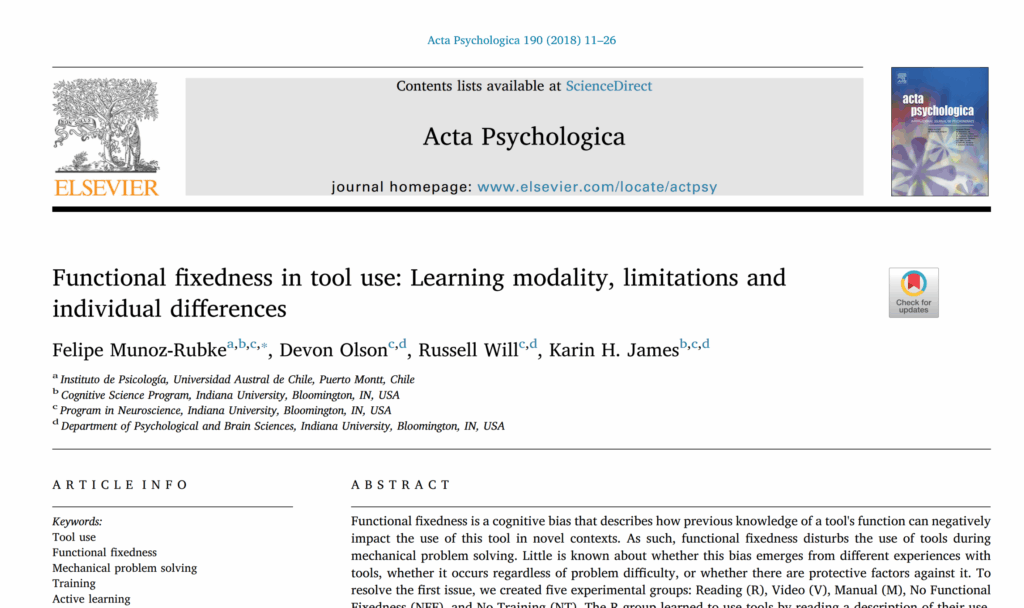
Munoz-Rubke, F., Olson, D., Will, R., & James, K. H. (2018). Functional fixedness in tool use: Learning modality, limitations and individual differences. Acta Psychologica, 190, 11–26.
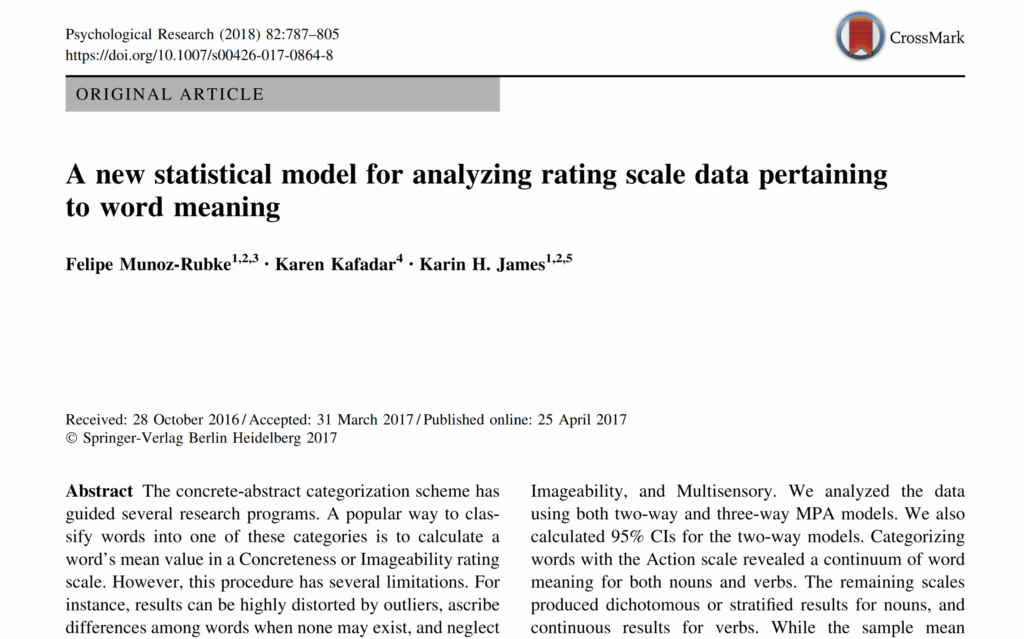
Munoz-Rubke, F., Kafadar, K., & James, K. H. (2018). A new statistical model for analyzing rating scale data pertaining to word meaning. Psychological Research, 82(4), 787–805.
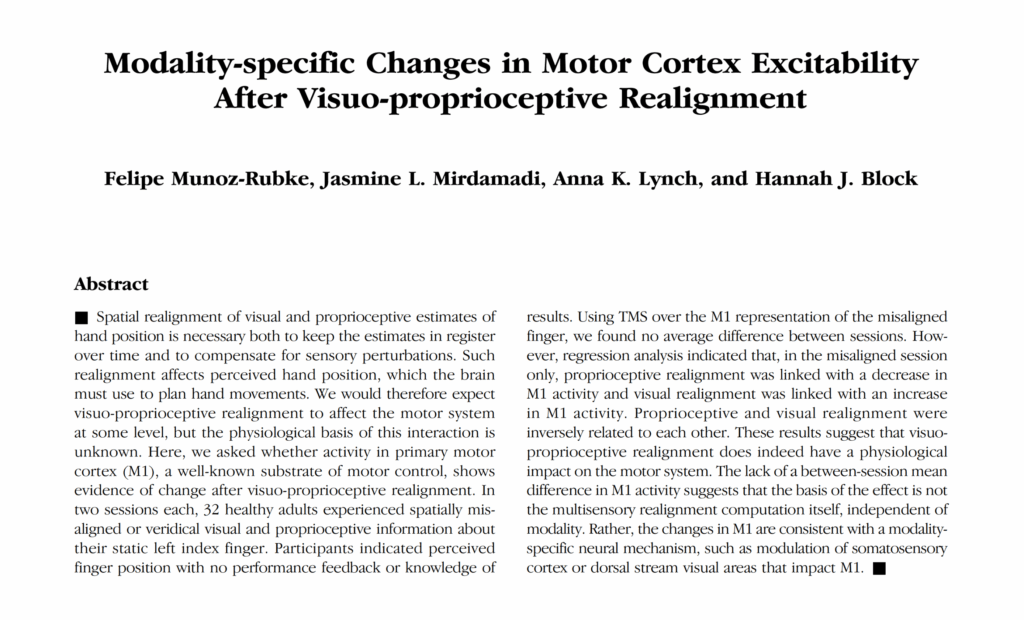
Munoz-Rubke, F., Mirdamadi, J. L., Lynch, A. K., & Block, H. J. (2017). Modality-specific changes in motor cortex excitability after visuo-proprioceptive realignment. Journal of Cognitive Neuroscience, 29(12), 2054–2067.
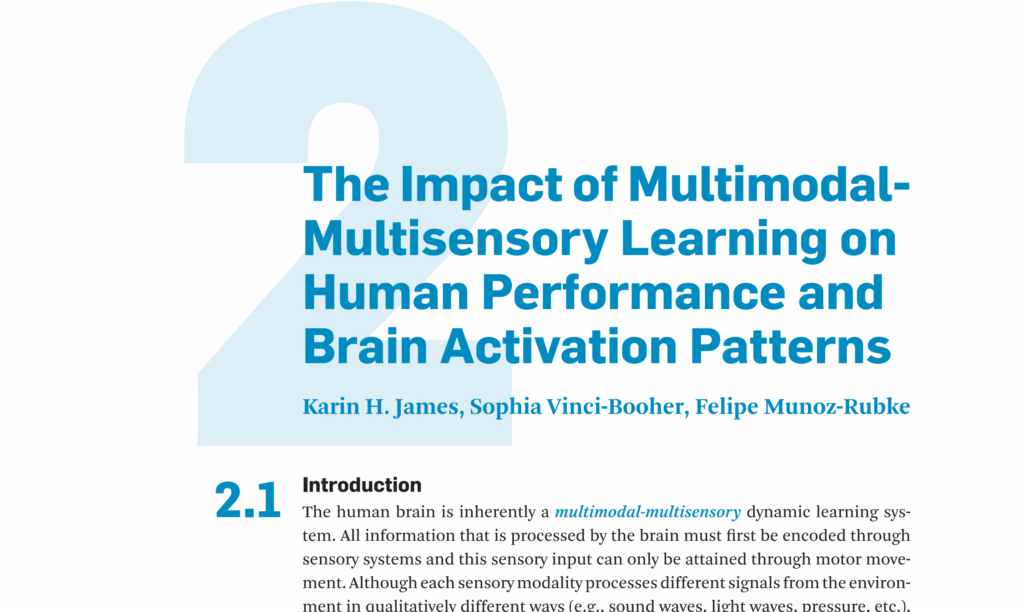
James, K. H., Vinci-Booher, S., & Munoz-Rubke, F. (2017). The impact of multimodal-multisensory learning on human performance and brain activation patterns. In S. Oviatt, B. Schuller, P. R. Cohen, D. Sonntag, G. Potamianos, & A. Krüger (Eds.), The handbook of multimodal-multisensor interfaces: Foundations, user modeling, and common modality combinations (Vol. 1, pp. 51–94). Association for Computing Machinery and Morgan & Claypool.
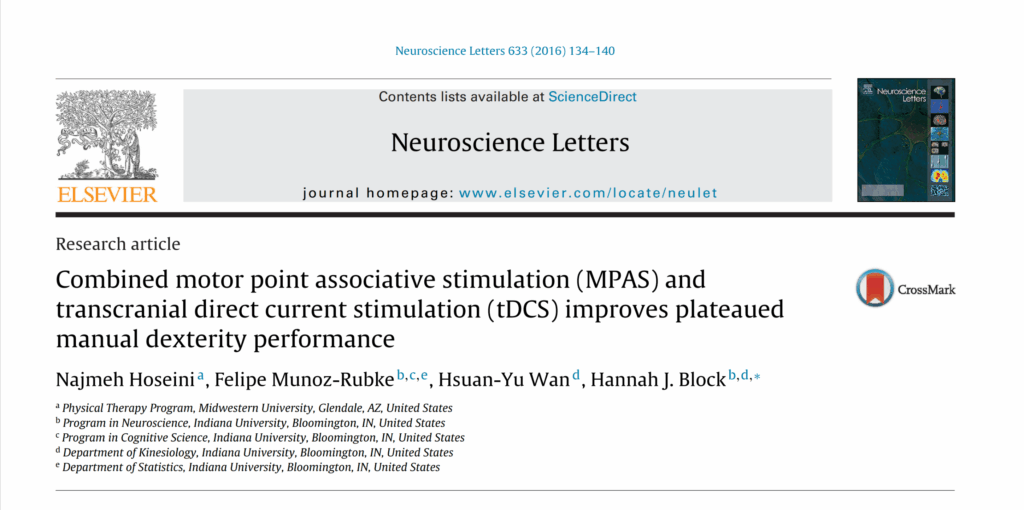
Hoseini, N., Munoz-Rubke, F., Wan, H.-Y., & Block, H. J. (2016). Combined motor point associative stimulation (MPAS) and transcranial direct current stimulation (tDCS) improves plateaued manual dexterity performance. Neuroscience Letters, 633, 134–140.
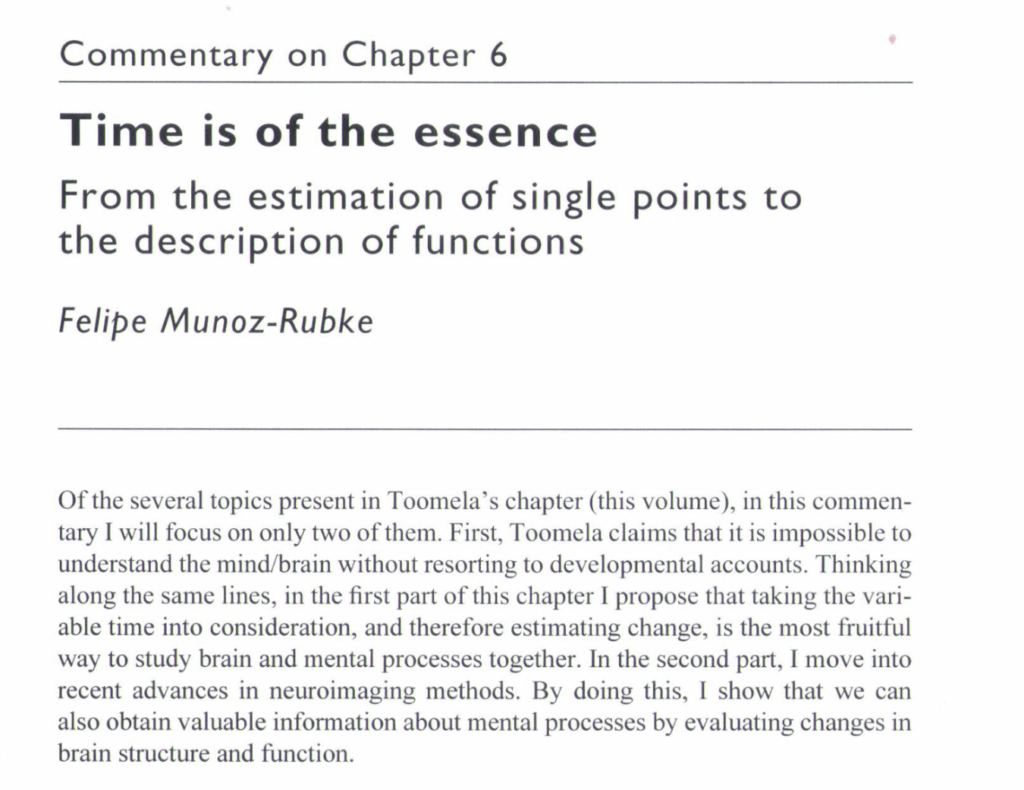
Munoz-Rubke, F. (2016). Time is of the essence: From the estimation of single points to the description of functions. In D. M. Carre, J. Valsiner, & S. Hampl (Eds.), Representing development: The social construction of models of change (pp. 179–186). Routledge.